
Rebuilding home with wounded hope
A mother’s journey across war-torn Ukraine
by Katie Livermore
Facebook video call interviews interpreted by Anastasiia Ragozina, OSU ‘25
Writer’s Note: Some translated quotes have been modified for grammatical correctness due to translation.
The Shell That Shattered Olena’s World
For 11 days, thundering military tanks made Olena Neirmeryk-Cherkashyna (Олена Неймерик-Черкашина) tremble in the basement.
The twelfth day was no different. Emerging from the basement each day, she’d relive the shock of her occupied hometown.
It had only been two weeks since Russia invaded Chuguev.
“Then one day came when I couldn't stand it anymore,” Olena said.
Ironically, Olena’s once quiet neighborhood was, in many aspects, the same. Cars still lined the block. People were still seen walking down the sidewalk. Towering trees and thick greenery still grew in glory, connecting houses upon houses of Ukrainian neighbors.
But this time, the people outside feared for their lives; the cars weren’t normal cars, they held Russian military gripping assault rifles; and the dominant shade of green had become the hue of military vehicles.
“Military equipment was constantly driving by and it was terrible,” Olena said. “When the tanks drive, everything around shakes. I remember a whole column of tanks was driving and they all stopped abruptly on our street and stood there for a very long time. It was very noisy, the house was shaking. I started to panic, burst into tears, called my mother and said goodbye to her, because I thought that they would shoot at us. After some time, the tanks moved on.”
Day and night, Olena and her family lived in the basement below her mother-in-law’s house, just over half a mile away from their home. The walls, floors and ceilings were concrete. There were no windows, no natural light and minimal space. The corridors were only two shoulder lengths apart.
The cold was the worst of all. They bundled up and huddled together for warmth–and comfort.
The day everything changed, Olena was wearing a lavender sweatsuit with a black parka zipped over it. Her white-blonde hair swished across her back as she described the basement and the war in a video. Olena’s husband, Yura, laid his back on the cement floor. He held a book above his head in the air, reading.
Sheathes of cardboard blocked storage shelves which held jugs of water and canned food. A wooden door and brick walls separated Olena and her family from the violence destroying their city above.
“Everyone was scared and we were in shock. No one knew what to do, where to run and whether there was any point in running,” Olena said. “The whole country was bombed, rockets were flying. But it was worse when the planes were flying. They flew low and fast. You were gripped by instant fear. We were in the basements almost all the time.”
There was no way out of Chuguev.
“We could not leave,” Olena said. “We sat in the storage under the house all nights in a row, it was very cold. We came home around 2 p.m. to prepare food, warm up and go to the basement again. Grocery stores were open for about three to four hours a day. People took apart everything that was on the shelves and very soon the products ran out.”
One evening, on her way upstairs from the basement, Olena’s outlook on life changed forever.
Olena kept her two sons, Oleksandr or “Sashko,” 10, and Miroslav, 4, attached to her hip as they entered the kitchen. At the counter, she sat them down at the table behind her. Her mother-in-law guarded the grandchildren.
Her husband, Yura, always watching, surveyed the scene as distant shells plunged from the sky. Olena began peeling potatoes in preparation for dinner, a staple of Ukrainian food. Sashko and Miroslav watched silently as each of the skins cascaded down to the cutting board.
Olena sliced steadily, but with fast movements. She wanted to return to the basement quickly.
“We come home from the basement to eat. I am cooking in the kitchen, and the children were sitting behind me at the table,” Olena said. “Then I hear a plane flying and the sound of a falling shell.
Craaaaaash. A sound Olena couldn’t describe in words.
An artillery shell cut the silence outside the Neirmeryk-Cherkashyna home. It exploded in a bone-chilling shatter.
“I return to the child, grab him and throw him on the floor, and I fall on top of him and cover him with myself,” Olena said. “Out of fright I forget to drop the knife I was holding in my hands, and I fall with my hand on it.”
When Olena realized the shell didn’t breach her roof, there was no time to waste. She lifted her sons off the ground when a stabbing pain coursed through her fingers.
She was shocked by the blood that soaked her lavender sweatshirt. The knife’s blade had pierced through her hand.
“Bleeding starts, but we have to run to the basement because the shelling starts.”
Boooom. Another shell.
“There was no time to think because planes were flying and there were explosions. My husband took me to the bathroom and ran for the first aid kit. My mother-in-law dressed my son and took him to the basement,” Olena explained. “My husband and I bandaged my hand and then also went down to the basement. It was a five-story building. We were on the 4th floor.”
After all normal aspects of life were already taken, the light was stolen, too. The Russian military–just under two miles from their home–shelled the Chuguev power plant and plunged the Neirmeryk-Cherkashyna family into darkness.
No internet, no lights and no heat.
“It is cold, dark and I am bleeding. I can no longer feel my fingers.”
That night, Olena stayed quiet in the basement with her family by her side.
“We all sat with flashlights…there wasn't much space, but we fit. It was scary that if a rocket hit the house, we would be crushed. I can't express the emotions we felt. To understand, you have to experience it.”
Yura called the hospital and an ambulance. Ring, ring, ring–the ring went on forever and nobody answered the phone. It was eerily silent in the basement.
“So we have to wait,” Olena said. “But the shelling did not end.”
Olena and her family remained in the basement, the entire house trembling above them.
“They were terrible sounds…we thought that nothing would be left of the city. But then everything began to subside,” Olena said.
Finally, the hospital returned the phone call–they were on their way.
“I was taken to the hospital, my arm was stitched up,” Olena said. “I stayed there until 6 a.m. in the morning. It was very cold in the hospital due to the lack of light.”
Looking back, Olena sees the situation as a “small thing” in the greater scope of the war.
“We thought three (of my) fingers wouldn't work at all anymore,” Olena said.
“Compared to other people who lost limbs, it's really nothing…
I was just lucky that the knife went into my arm and not my stomach.”
After this, Olena decided: they were fleeing home.
Olena’s home is no more
Every day, the city of Chuguev began working at 7 a.m. They were the “get-up-and-go” of Ukraine.
That night, Olena expected to join them as usual, to wake up in the morning and welcome customers–parents and their children–into her family’s toy store.
But in Chuguev, it was Feb. 24, 2022–a day never to be forgotten for Ukrainians worldwide. It’s the day Olena’s city was first attacked.
Still, Chuguev is nestled in Olena’s mind as her cozy city.
With a population of roughly 40,000 people, Chuguev sits in the Kharkiv Oblast region. It is located approximately 15 miles from Kharkiv, which is Ukraine’s second-largest city after Kiev. The Siverskyi Donets River, grayish blue and glassy, meanders through schools and parks.
“In general, this is a small city in which we lived and worked, but every weekend we went to Kharkiv with our children,” Olena said. “There are huge beautiful parks and many shopping centers. The largest square in Europe. This is a very beautiful city.”
In Kharkiv, families like Olena’s visited Shevchenko City Garden, filled with fountains and greenery. Neighboring the park was the Kharkiv Zoo, the oldest zoo in Ukraine, that still holds polar bears, elephants, bears, birds, reptiles, big cats and more.
The city was a reflection of its people and their needs. The zoo and parks were free. Public transportation and filtered water, which usually required coins to purchase in Europe, was free in Kharkiv.
On February 5, 2022, just weeks before Russia invaded, Olena took a video of Sashko admiring Fantasy Park in Kharkiv from a bench. An excited Sashko smiles at the camera as Olena pans over to plant-like lights dancing from the ground in unison. Multi-color fixtures hang from wires like candy chandeliers. Gumdrop bulbs light the snow and sky in blues, reds, purples and greens.
“It’s so beautiful–how could anyone not love it?” Olena said.
Olena reminisces on her cozy childhood
Born in Kiev in 1988, Olena moved to Chuguev when she was just an infant. She describes her childhood as idyllic. She was happy to be born into her loving family with two parents and a sister.
Ukraine was still part of the Soviet Union–heavily shaped by Joseph Stalin and communism–when Olena was young. When she was three years old, the USSR collapsed. Though her memory of the time is faint, Olena still remembers glimpses of Ukraine’s past.
Olena’s father was a television technician and her mother worked in merchandising. Olena remembers her mother donning a white uniform while she worked at their local store. She sold sour cream and milk in big, metal jars.
“They often took me with them to work,” Olena said. “My mother and I stood behind the counter and (I) helped her sell the goods.”
Under communism, people were oftentimes paid in local products, such as condensed milk. In her childhood, small candies and Coca Cola were novelties. In eighth grade, the first McDonald’s opened in Kharkiv–it was a big event.
“Everything from abroad was very special, very little available,” Olena explained.
Ukraine was not unfamiliar to finding its own identity again. With a nearly 200-year mission to tyrannize Ukraine, Russian oppression always lurked in the shadows. The oppression produced an even stronger Ukrainian identity–anything that separated them from Russia became that much more popular (Owens, 2024).
It wasn’t until 1995 that Ukraine slowly began finding its own voice again, particularly in its economy, away from communism. The government began giving away land and apartments to nearby factory workers, and relocated other Ukrainians for jobs in different cities.
Olena grew up in a large, two-story house, perfect for hosting. Around the holidays, her classmates would visit her house for celebrations, food and entertainment. On the weekends, her parents would take Olena and her sister to Kharkiv.
All Olena’s friends expressed their jealousy of how she lived as a child, Olena said. She remembers how the neighborhood would gather at her family’s home.
During summers in Ukraine, Olena lived in her grandmother’s village of Kluhyno-Bashkyrivka in Chuguev. Her grandma often cooked warm crepes and shared Ukrainian dishes with friends from the village.
“I picked sunflowers there, dried the seeds and sold them to neighbors,” Olena messaged with a laughing emoji.
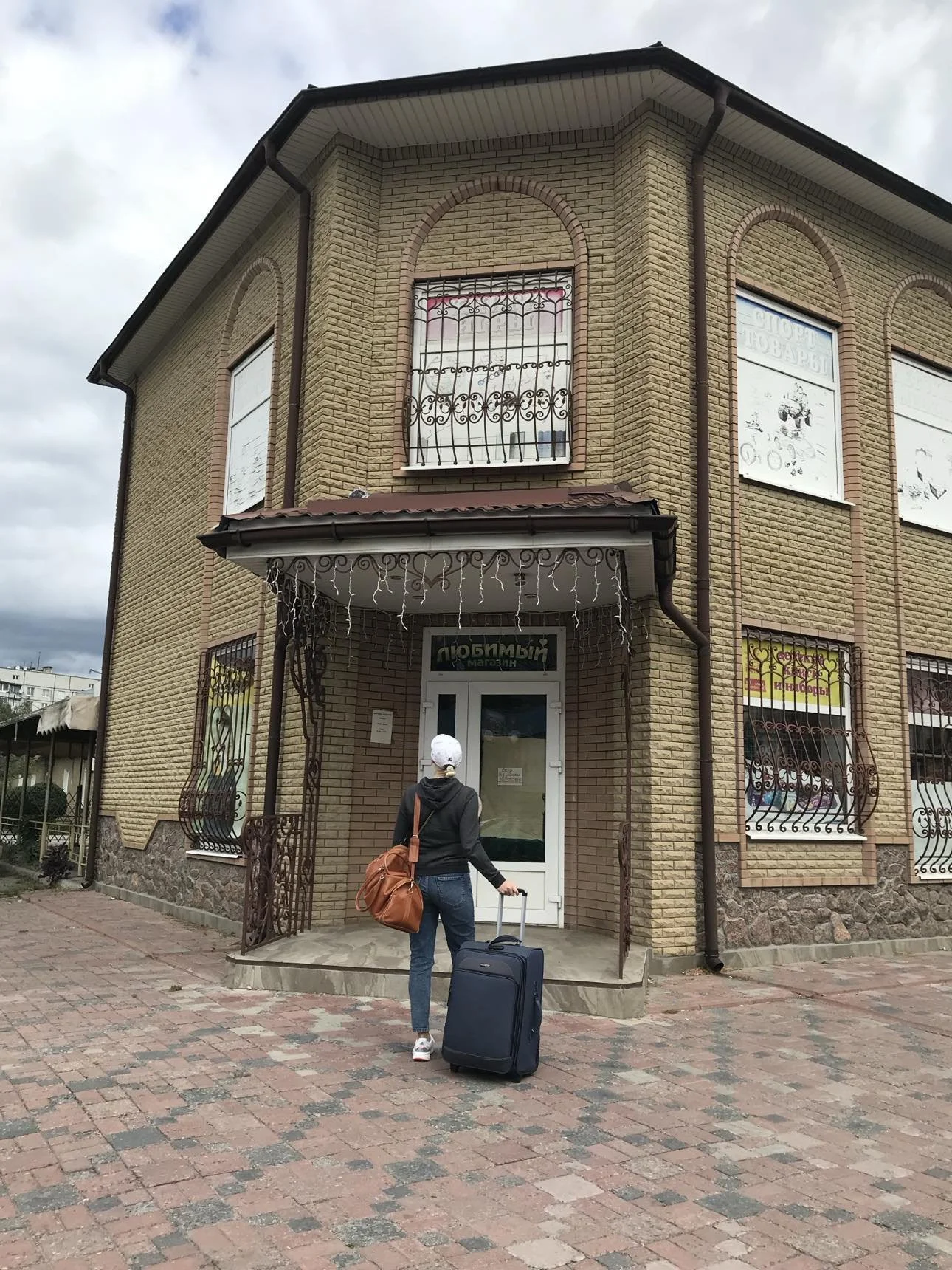
Olena’s parents opened their family store when she was a child. Named “Favorite,” or Любимый, in Russian, the store held the allure of children’s favorite things growing up: toys, stuffed animals and colorful clothing.
“(My) parents often traveled abroad to buy goods,” Olena said. “At first we had a small kiosk, then my parents rented a room and at the same time built a store. It took many years to build and finally in 2010 we opened it.”
When she was young, Olena dreamed of becoming a model and actress. When she was 10 years old, she and her neighbor friends organized shows for pensioners that lived nearby. They wrote and performed scenes, choreographed dances and even did comedy skits.
She modeled with an agency for a while, but her parents didn’t believe it was an “appropriate” career. Instead, they sent her to study at the National Academy of Legal Sciences of Ukraine in Kharkiv–a site that is now rubble after attacks in January 2024.
Her character and positivity stems from her parents. Even her name “Olena” reflects her personality: it means “sunray” or “shining light” in Ukrainian culture. Her parents gave her a strong education and plenty of love. Olena was very close with her father. When she was a child, Olena’s dad braided her hair. He brought her on trips to the sea, pretending he was a turtle swimming underwater. They often played together with her toys.
In 2020, her father passed away. Olena’s heart broke.
Her father gone, the rest of Olena’s family was spread across Europe–even her son, Sashko, no longer lived with her.
Olena’s mother moved to Germany just months after the war began. She took Sashko under her wing, as air alerts and the threat of war terrified him in Ukraine. By June 2022, they were living in Germany.
“My mother is a wonderful person, and if something happens, I can always rely on her. It is not easy for her in Germany, especially because she does not know the language,” Olena said in a message. “Because of Sashko, she does not leave.”
Though Olena is grateful for their safety and comfort, she misses them both.
“Sashko has already integrated in Germany and does not want to return to Ukraine,” Olena said. “This is very sad, because I want to live in Ukraine, but he does not.”
In August 2025, Olena visited her mother and Sashko again to experience their new life.
The rest of her family is scattered: Olena’s mother-in-law is now in Italy and her sister moved to Germany. Due to the war, Olena and her sister no longer talk to one another.
“I don't want to add anything about my sister,” Olena said in a message. “It just so happened that after she left for Germany, she stopped communicating with me and my mother.”
Olena’s ‘Favorite’ business in Chuguev
Olena and Yura, like many early risers of Chuguev, opened Favorite’s doors early each day at 8 a.m. Olena loved inviting children and families inside to shop, and decorating Favorite festively for each holiday was Olena’s greatest joy.
For Christmas, Olena and her family would collect leaves from the streets outside and make their own decorations. They always had a Christmas tree around the winter season, selling ornaments and other tree decorations for Ukrainian families.
Olena treated her customers like family. Many visited with their children for fun. She’d give out stickers and balloons to brighten their day.
She refers to Favorite as a "soul," rather than a business. Favorite lived in a brick building rose up from red, beige and black tiles sprawling in diamond patterns. With two stories, Favorite was decorated in wrought-iron bars adorned with heart and curl patterns.
At 6:30 p.m. each day, Olena would lock Favorite’s doors and return home to her family. Other days, Olena’s husband and sons joined her in the gratification of the family business, too.
“Sometimes we even had to take the children when we went to Kharkiv to buy goods,” Olena said. “They loved it very much, since I bought goods for the store and at the same time toys for them.”
Since she worked all day, Olena brought her sons along to Favorite when she had nobody to watch them. She loved watching them interact with the customers and find excitement by the new toy deliveries.
“Miroslav was then still small, 4-5 years old, and wanted to help me. If some customers came in, he simply took all the goods from the window one by one, approached people and offered them to buy them,” Olena said with a laughter emoji in her message.
Favorite was another home for Olena, where her family, friends and new faces gathered around a common love of children.
Before the war, she thought of her customers, always trying to grow their business for families in Chuguev to enjoy. Now, she misses the store every day.
“I worked there since I was a child,” Olena said. “I never imagined that I would do anything else.”
Olena wakes to her nightmare
In the middle of the night on February 24, 2022, Olena awoke to thundering gunfire.
“I immediately understood that the war had begun. It became very scary. Through the window, we saw how two rockets collided in the air and exploded,” Olena explained. “We started putting things together. I called my mom and told her to start packing, too.”
So they packed. Quickly, as if their life depended on it. Because it did.
Olena opened Facebook to investigate the situation. Reading the news, she quickly gathered where Russia had invaded–close to home.
“In general, everyone talked about the war among themselves, but no one thought that Russia would still attack,” Olena explained. “We hoped that everything would be resolved peacefully.”
What Olena originally thought would be resolved between Russia and Ukraine tore apart her beloved city instead. As quickly as she packed, she discovered that the Kharkiv region wasn’t alone in their attack.
“Acquaintances from different cities wrote about explosions undermining airports,” Olena said. “There is also a military airfield in my city. And near it there were a lot of five-story buildings where people lived. This district was the first to suffer. These buildings are almost all destroyed.”
The only quick source for news was Facebook, and most of it held updates from friends, family and neighbors.
Olena and Yura discussed the safest place for their family, landing on Yura’s mother’s house. There was a basement they could use as a bomb shelter, unlike Olena’s family home.
She often sent photos of buildings destroyed by Russian attacks in her city.
“On the very first day we started running to the basement,” Olena said. “The sirens weren't working in the city yet and we were guided by the sound of planes and explosions. A plane is flying - that means we need to run for cover.”
Only, they had to venture outside–where missiles were exploding in tectonic booms–to then prepare for a life indoors.
“Imagine that you are standing in a relaxed state and suddenly lightning and thunder strike next to you,” Olena said. “Fear, madness. Feeling like you are in hell. You don't know where to run, what to do.”
Knowing what awaited them outside, Olena and Yura left their sons with Olena’s mother-in-law and ventured outside to stock up on food and medicine.
“There were queues everywhere,” Olena explained. “There was only one bread stand and two pharmacies in the entire city. We stood in lines for two hours for bread and medicine. Firing was heard somewhere far away. We understood that the fighting was going on in Kharkiv.”
The lack of bread was a startling reminder of Holodomor, Ukrainian for “man-made famine,” when Stalin purposely stole wheat from Ukrainians in attempt to break the success of Ukraine in the late 1920s. Feeling threatened by their rising autonomy, he controlled the export of grain.
Farmers were forced to surrender everything: livestock, farming tools and land. Those who resisted were imprisoned, killed or sent to labor camps. About 3.5 to 7 million Ukrainians were killed in Holodomor (Holodomor, n.d.).
Now it’s just another haunting reminder of the centuries Russian regimes have oppressed Ukrainians.
Olena, along with many other Ukrainians, weren't expecting war. They hoped the invasion would end within a few days and everyone would be able to return home.
Instead, it only escalated.
Returning to Facebook for news, Olena discovered that the Russian military allegedly shot every civilian and every car that drove along the route. This was reported on Facebook by other Ukrainians fleeing their homes, which terrified Olena.
They heard of a place called Uzhhorod, located so far West that no Russian missiles reached the city.
However, the only way to this safe haven was the Chuguev-Kharkiv route. So, Olena, Yura, his mother and Miroslav waited. They shivered quietly in the cold. They held their breath below, hoping none of the sounds would result in a shell crashing through the ceiling.
Either from the cold or the stress, Miroslav fell ill one night. Worried about his health, Olena and Yura jumped to action.
“I had to get medicine somewhere. I wrote on Facebook and one girl replied that she had such medicines,” Olena said. “Since (Ukraine) introduced a curfew, it was impossible to leave the house in the evening, even our territorial defense could shoot.”
In the position of choosing his son’s life or his own, Yura chose Miroslav. With a flashlight, he set out at night to find the girl and bring Miroslav medicine.
“The lights were out in the city, it was dark outside, it was curfew, and it was forbidden to go outside,” Olena said in a message. “Even our own people could shoot us. But, fortunately, Yura didn't meet anyone on the way.”
In the midst of the war, Olena and Yura still found ways to lend their strength to the community. From their own home, they gathered pillows, clothes and water to the hospital to share with others.
“Hospitals were full of people. Many wounded, dead,” Olena described. “We helped as much as we could.”
Where Olena’s business stumbled upon love
Olena and Yura are both business and civic-minded. They’re always finding ways to make money and love to make it an exciting adventure.
But their first meeting was rocky. It started with Yura selling shoes in front of Olena’s business.
Ten years ago, Yura’s friend gave him sample shoes to sell on the street. The shoes were prototypes before the official launch. They were all one size and one color–not ones ready to be sold as official products in a store.
So, Yura loaded them up in his car to sell the shoes himself. Since Favorite is located in the center of the Chuguev with prime foot traffic, Yura thought it would be the best location. He popped open his trunk and began chatting with prospective customers.
Olena was selling school supplies, however, at a table in the summer outside Favorite with her sister. When she saw Yura, her blood began to boil.
In her eyes, Yura was competition to her family store.
Seeing Yura sell shoes so close to her family store, Olena decided to leave her spot and tell him off. She told him he couldn’t be there. She tried to get him to leave, but he wouldn’t.
Instead, Olena was charmed by Yura. They began spending time together. However, Olena’s grandmother forbade the relationship because of Yura’s license plate number: 666.
With her superstitious nature, she believed Yura enchanted Olena so she would fall in love with him. One day, Olena injured her leg, so Yura brought her a healing ointment.
Olena’s grandmother advised her granddaughter to discard the ointment, suspecting it was poisoned. After a while, Olena’s grandmother gave in. She realized how loving Yura was–not an evil person as she initially believed.
To Yura, Olena is the only person in the world for him. He said he has never met anyone like her. She is special, smart and pretty–all at once. To Olena, Yura has always been a man of his word. If he makes a promise, he keeps it.
Before meeting Olena, Yura finished university with a degree in car mechanics. He completed a few internships around the time they first met outside Favorite. It was difficult to find a job fresh out of university.
Instead, the couple decided to open their own small car business, with Yura heading the business. They travelled by train across the country, purchased cars in need of care, deep cleaned the interior and sold them around Ukraine. It was a quick-paced job that required fast thinking.
“Since I sometimes went with Yura to pick up cars around Ukraine, I helped them get them in order,” Olena said. “Upon arriving in Uzhgorod, we decided to open a detailing wash.”
Little did they know, the car business would have a future in Uzhhorod they never anticipated.
Olena leaves her life behind
“There comes a time for departure even when there is no certain place to go”– Tennessee Williams
After the knife pierced Olena’s hand, she decided: they must leave their home in Chuguev. It was only 12 days after Russia invaded.
The Russian military wasn’t so accommodating to those fleeing eastern Ukraine to safety. Olena explained how they stood on the highway and shot civilians.
Olena needed to find the safest route.
“Then I saw photographs and videos from those places,” Olena said. “There were a lot of cars shot up and people killed.”
Olena and Yura stocked up enough food and water to trek nearly 17 hours across the country.
“We traveled to Uzhhorod for four days,” Olena said. “There were traffic jams almost everywhere. We could not move at all for several hours.”
With the Russian military just under two miles away from the Neirmeryk-Cherkashyna house, it wouldn’t be easy to escape. Olena’s family drove nearly 17 hours through their war-torn country to reach Ukraine’s safe zone–Uzhhorod.
“It was still scary to drive on the road, hearing explosions in the distance,” Olena said. “There is nowhere to hide. Most of all, I was afraid for my son. Because no child deserves this.”
Olena’s friends had left earlier to Poltava, just two and a half hours outside of Chuguev. They rented an apartment and hosted Olena’s family during their first night of the journey. There wasn’t much space in the apartment, though Olena was grateful for a place to stay. That night, they slept on the bare floor.
Driving wasn’t exactly the quick-paced movement of everyday occurrences. Oftentimes, traffic slowed Olena’s car. She sent a video of Yura, scooping freeze-dried coffee from a jar in the backseat, as they stood in traffic.
“This is us standing on the highway,” Olena said in a video, as sleet hit the windows of the car. “Yura is making us coffee while we stand and wait for the traffic jam to clear. He just got out of the car and made coffee.”
In the driver’s seat, Miroslav pretends to drive the car to safety, turning the steering wheel back and forth.
On the second night, they stayed in Poltava again with other friends. They couldn’t leave because gas stations had run dry. Ukrainians fleeing their homes waited in line for hours to fuel up for the road ahead.
In the throws of winter.
“The next night we slept in the car,” Olena said. “It was very cold and uncomfortable.”
Finally, they arrived in Uzhhorod and settled into a hostel. It was a place where they didn’t know a single soul except each other.
“It was very scary to leave my home,” Olena said. “You don't know how far you're going, where you're going, or if someone is waiting for you there. This is just a path into the unknown.”
Home is built by holding hands
Olena’s family has been living in Uzhhorod for more than three years.
Instead of their modest-sized house with a rolling green lawn and “Favorite” down the street, they were first crammed into a hostel. Different shades of cream-colored paints chipped and peeled off the walls. Herringbone planks threatened to bulge out the floors.
“It's a foreign city, bad living conditions in this hostel,” Olena said. “I really wanted to go home. But it was impossible.”
Olena spiraled into a deep depression.
“I sat in the room and didn't want to go out at all,” Olena recalled. “It was such a feeling of desolation, as if nothing good would ever happen in our lives.”
The hostel, where Olena’s family lived for the first two years of the war, was once a dorm of Uzhhorod University. Olena, Yura, Miroslav–and Sashko and Olena’s mother-in-law, for a few months–all squeezed into a 215-square-foot room, built to fit two college students.
They shared everything with other internally displaced Ukrainians. The many residents shared bathrooms, kitchens and laundry rooms. Any sense of privacy was gone.
Shared spaces, like laundry and bathrooms, were common at hostels in Uzhhorod. This is the hostel where Olena’s family lived when they first arrived.
Miroslav was allergic to something in the hostel, but they never discovered what it was. But, it was bad enough for them to move. Miroslav often contracted Rotavirus, and Olena was forced to bring him to the hospital.
“In the hostel there is always dust and dirt. I want the children to grow up in normal conditions. We work 24/7, but since we recently started doing detailing, there are clients, but not as many as we would like,” Olena said after they moved. “Therefore, we are now working on renting an apartment and renting the premises in which we work.”
War through a child’s eyes
Miroslav section with quotes (potentially, if we feel we should have it)
Though Uzhhorod is considered a “safe zone,” air alerts–sirens warning of missiles coming West–blare through the streets in piercing screams.
Sashko’s hands shook as he heard the alerts. He’s witnessed firsthand what can follow these sirens in Chuguev.
“He was afraid of alarms and when he heard a siren, his legs and arms started shaking and he had nightmares at night,” Olena explained.
Because of this, he studied at home with Olena, taking his classes online. Since June 2022, he’s lived with his grandmother far away in Germany. Now, Sashko has assimilated with German culture and language. However, Sashko was forced to trade his parents and brother for safety.
Olena, Yura and Miroslav pose for a photo at Miroslav’s school in Uzhhorod.
“Many people are afraid for the first half hour after arrival (of air alerts), and the rest of the time they live as if nothing had happened,” Olena said. “We're already used to it. You have to live, you have to work.”
Miroslav attends school in person in Uzhhorod, but every time an air alert signals for a missile, the children must run for cover. Sandbags stacked up to the ceiling block all windows of classrooms. In Ukraine, recess outside doesn’t exist.
“We left (Chuguev) when (Miroslav) was 5 years old,” Olena said.
All Miroslav remembers from Chuguev is kindergarten and visiting Kharkiv during the weekends. However, when asked if he wants to return to Chuguev, he nods his head with excitement.
Miroslav is not unlike many children around the world.
He attends school with classes such as music, math design and technology, art, and physical education. In his design class, he creates new technologies, including an airplane tied with thread to fly.
Miroslav takes a gradebook to school each day where his teachers write his daily assignment grades–he shows this book proudly, presenting a multitude of high “A” marks.
He’s learning English and Ukrainian, and dreams of becoming a YouTuber one day. Above all, he wants to visit Universal Studios in the United States to visit Harry Potter Land. Miroslav reads many books, but his favorite series is the story of a young boy living through a war–in the wizarding world.
Every night, he falls asleep reading a similar story to the one he is living.
Dreaming of home in Chuguev
Olena built a beautiful life with her family. She had a large house–perfect for her family–that she made a home.
She loved the living room, which had a big couch, armchairs and a large television. In the evenings, the family would gather and watch movies. Her favorite room was the “fireplace room.” During the winter, they would often light a hot fire and make dinner. They’d wrap potatoes in foil and stick it right in the fireplace to cook.
“Sashko’s piano was in that room too, and he would play different music for us,” Olena said. “It was so cozy and atmospheric. I really miss it.”
The yard was another extension of Olena’s beloved home. There was a large wooden swing, lots of arborvitae, juniper and roses.
Olena poses for a photo with her sons, Sashko and Miroslav, in matching outfits during Christmastime.
“The spring before the war, my mom and I planted 101 rose bushes,” Olena said. “They’re all gone now… it’s really heartbreaking.”
Summers meant dinner outside, with fruit pies Olena baked using produce from the garden, which was about one-third of an acre in size.
“We had a big garden,” Olena said. “It had apricots, strawberries, blackberries, raspberries, gooseberries, and many other berries.”
Now, Olena dreams of home before war.
Olena returns to a war-torn city
Olena returned to Chuguev in August, 2024, two years after Russia began its full-scale invasion.
It was not how she remembered her beloved city.
Olena’s neighbor told her the windows in her house in Chuguev were broken, the gate lock was gone and the house was vandalized.
“At the end of March, we found out that a rocket landed next to our house…Even later we found out that since there were no windows, the (radiator) in the house exploded and now there is no gas or water,” Olena said. “It is necessary to make a complete repair.”
She discovered firsthand the house that held her fondest memories of her children's laughter in a broken mess.
“I went inside. Everything is so terrible there, there are a lot of cobwebs and shards of glass and it is very dark,” Olena described. “This is now a bloody house for celebrating Halloween,” she noted with a laughing emoji in her message with photos, adding humor to cope with the pain.
Olena’s family home was destroyed from the inside out, blasting glass from windows.
“When the rocket landed in Chuguev recently, the doors of our store opened!” Olena said.
“People came in and out until some man closed the door with special tools.
I did not know this until I arrived in Chuguev.”
Nearly a year later, in June 2025, a neighbor sent a photo of Olena’s fence
with the Russian word “занято,” which translates to “occupied.”
Olena thought the Russian military had overtaken her house.
“I'm going to go home,” Olena said in a message. “The military has moved in or wants to move in, or maybe looters. I need to go home now, figure it out.”
Olena, taking business classes in Uzhhorod, couldn’t travel across the country to reclaim her house. Instead, she called the police, neighbors and friends for help.
“The police talked to the military, they left,” Olena said in another message. “I have already hired a person, they painted my fence, mowed the weeds to create the appearance of a residential building.”
Every couple of weeks, Olena sends and posts videos depicting how war is tearing apart Chuguev, Kharkiv and other cities in Ukraine. There are fiery explosions. Cars with their metal melted into the street. Columns of thick, black smoke ascending into the sky from residential buildings, not too different from Olena’s house.
On June 10, 2025, a woman Olena knew was killed, struck by a missile in her garden.
A missile struck near Favorite, decimating Miroslav’s kindergarten. Layers of classrooms sit exposed in their concrete form. The windows are black, gaping holes. A place, once filled with eager children and bright futures–destroyed.
Miroslav’s kindergarten building in Chuguev was decimated by Russian missiles.
Now, their future is at risk of extinction. At least, a future in their home country.
The new life Olena never saw coming
Olena described the move as being thrown out of a natural habitat into an unknown one, where she has to learn everything over again.
Different people. New city. Another job.
“Uzhhorod is very different from my city. The people, the mentality of people, their habits, work schedule, and lifestyle are also different,” Olena explained. “I’m still getting used to everything. In my city, people start working very early, and on Sunday the shops are also open. In Uzhhorod, work usually starts at 10 a.m., and on Sunday all stores are closed except for grocery stores.”
In Kharkiv, the infrastructure was more developed. Olena grew up with trimmed parks, well-paved roads and a clean environment. In Uzhhorod, she said, this is not the case.
Kharkiv recently built a new European rollercoaster at the amusement park. There was a giant lake with a fake pirate ship with ducks and other birds flying around the natural areas. In Uzhhorod, many of the rollercoasters and amusement parks are still from the Soviet Union and can be dangerous to enter.
Kharkiv is modern, clean and new. If there was a pothole or issue in the road, the next day it would be fixed. On the other hand, a road in Uzhhorod wouldn’t be fixed for years.
Kharkiv has the most universities in Ukraine. Many people flock to Kharkiv to earn prestigious degrees. The city has specialty doctors for niche medical problems. In Uzhhorod, people usually travel across the border to other European countries for their healthcare needs.
Now, with millions of new people in Uzhhorod, the city is adapting. With Ukrainians from Kiev and Kharkiv, there’s a new bar to reach. There are more trash cans and infrastructure developments, but it still isn’t close to the modernity of Kharkiv, Olena said.
Olena’s tension with Ukraine’s power-hungry neighbor
Olena has made many friends in Uzhhorod, but there is one aspect of the Olena’s family’s life that many Uzhhorodians don’t agree with.
They speak Russian.
While the reasons for Russia declaring war on Ukraine are historically charged by many different aspects of the Russian government and their president, Vladimir Putin, in Ukrainians’ eyes, not all reasons are the same.
Kharkiv is the largest capital city closest to the Russian border, which means many Ukrainian citizens often speak the Russian language rather than Ukrainian.
For some Ukrainians, Olena said, the Russian-speaking Ukrainians are who started a war in the first place by giving Russia a reason to take over: there were already Russian-speaking people in Ukraine.
“They sincerely believe that the war started precisely because of this,” Olena explained.
So, removed from their homes and living as outcasts in a new city, Olena dreams of her old life–where air alerts don’t chain their son to a life indoors and neighbors don’t judge her family for the language they speak.
Though often brimming with positivity, Olena voices her disdain for Putin and the Russian government.
“Imagine that you live at home, live well, enjoy life, and raise children,” Olena explained. “One day your neighbor, who envied that you were living better, broke into your house at night and kicked you out…now you are on the street with your family and a small suitcase of things and you have nowhere to go. You must build your life anew, look for a new home. You didn't ask for all this. What emotions will you have towards this person? Misunderstanding why this happened and why no one can influence him and kick him out of your house and give you back your life.”
Olena doesn’t hate Russia, but she wishes it didn’t exist on the map at all, for the evil the government has brought on innocent people.
“No war is worth so many lives lost,” Olena said. “No war is worth children growing up without fathers, mothers or in an orphanage. No war is worth parents burying their children prematurely. There is always another way, the path of goodness and love. Life is so short, so let's live it happily.”
Olena dreams of other ways to spend Ukraine’s money. Instead of weapons, she wants to build new hospitals, improve cities and support Ukrainians in need.
“I don’t understand how people can voluntarily kill their neighbors and take away their homes,” Olena said. “Now is the time, the time of technology, progress.”
Olena, like many Ukrainians, wants peace. But with meetings in 2025 between Ukraine President Volodymyr Zelensky, United States President Donald Trump and Putin, Olena feels misunderstood and betrayed.
“Peace cannot be built on the betrayal of those who gave their lives for this land. How can the U.S. president dispose of someone else's land without even living there, without communicating with Ukrainians? Not with the authorities, but with ordinary people!”
Olena wants for government officials to consult the people who live in war-torn land about its future; not other authorities who don’t share the same roots and love of Ukraine as Ukrainians do.
“He doesn't want to ask us what we want? How can we give our homes, lands to murderers, invaders?” Olena said in a message. “It's easy to dispose of someone else's property, but if it were up to (Trump), I don't think he would give his to anyone.”
For Olena, it’s difficult to have hope.
“You just sit and wait for the war to end and people to stop dying. It's hard to hope when you see reality every day,” Olena said. “You wake up, read the news, and there are (missiles) again in your (home) city. Or when you’re talking on the phone with a friend, and you hear explosions on her phone…you just pray that she'll be okay.”
Olena spreads light through her mourning community
Despite this, Olena still shares her compassion with others and receives the same in return.
Even in a city she hasn’t quite warmed up to yet, Olena is making a new life for herself and her family. Upon moving into the hostel, she quickly got to work.
International organizations sent washing machines and dryers. Olena arranged to have refrigerators on two floors for common use. After Corvallis Sister Cities Association visited, they sent cabinets, fans, irons and more household items for those living in the dormitory.
With her kind heart, Olena ensured children in the hostel still experienced joy. The true soul of Favorite, Olena brought Christmas to the hostel halls with improvised materials.
“Before Christmas, I held a master class for children. We sewed Santa's boot and at night I put sweets in each child's boot,” Olena said.
Olena’s goal was to ensure Ukrainians in her hostel were well cared for. She lived through her depression and lifted others up when their lives were turned upside down.
“I looked for different organizations that help with food,” Olena said. “I called the companies I had previously worked with and asked them to send me new children’s clothing for the children (in) the hostel. My husband and I also organized a trip for these children to Bukovel (a resort in the mountains). For the New Year, I organized a party and gifts for children.”
Now, Olena has a circle of friends she has become closer with after the war began. Still, she dreams of Chuguev and the life she built back home.
Olena was the Santa Claus of the dorm in Uzhhorod, sneaking treats into the stockings at night for children to open Christmas morning.
Olena’s dream is for Ukraine to bloom
“I want to see the world, because it is so beautiful,” Olena said in 2024. “We have been sitting in a cage for (three) years.”
Olena and Yura hope that someday, people from all over the world experience their country’s beauty. During their travels, the couple experienced the array of Ukraine’s rich cultures, different in each part of the country.
They believe every city in Ukraine is special, but their heart will always live in Chuguev. Before the war, Olena took life for granted. Now, she stresses not to waste time. Profess your love, travel, dance.
“I didn’t understand that in just a split second it could be gone,” Olena said. “Now I appreciate every moment of life…after all, tomorrow may not come. Don't miss the opportunity to be happy while you can.”
They hope others–both inside and outside of Ukraine–will come to know the intelligence and compassion of Ukrainians. They hope the world will notice how Ukrainians are unique, apart from the rest of Europe–especially Russia. They hope Ukraine will bloom.
“I really want to go home. We just live day by day, hoping to return,” Olena said.

